CATALYST
DENVER MUSEUM OF NATURE & SCIENCE ONLINE MAGAZINE
2026 Symposium Tackles the Role of Politics & Policy in Science
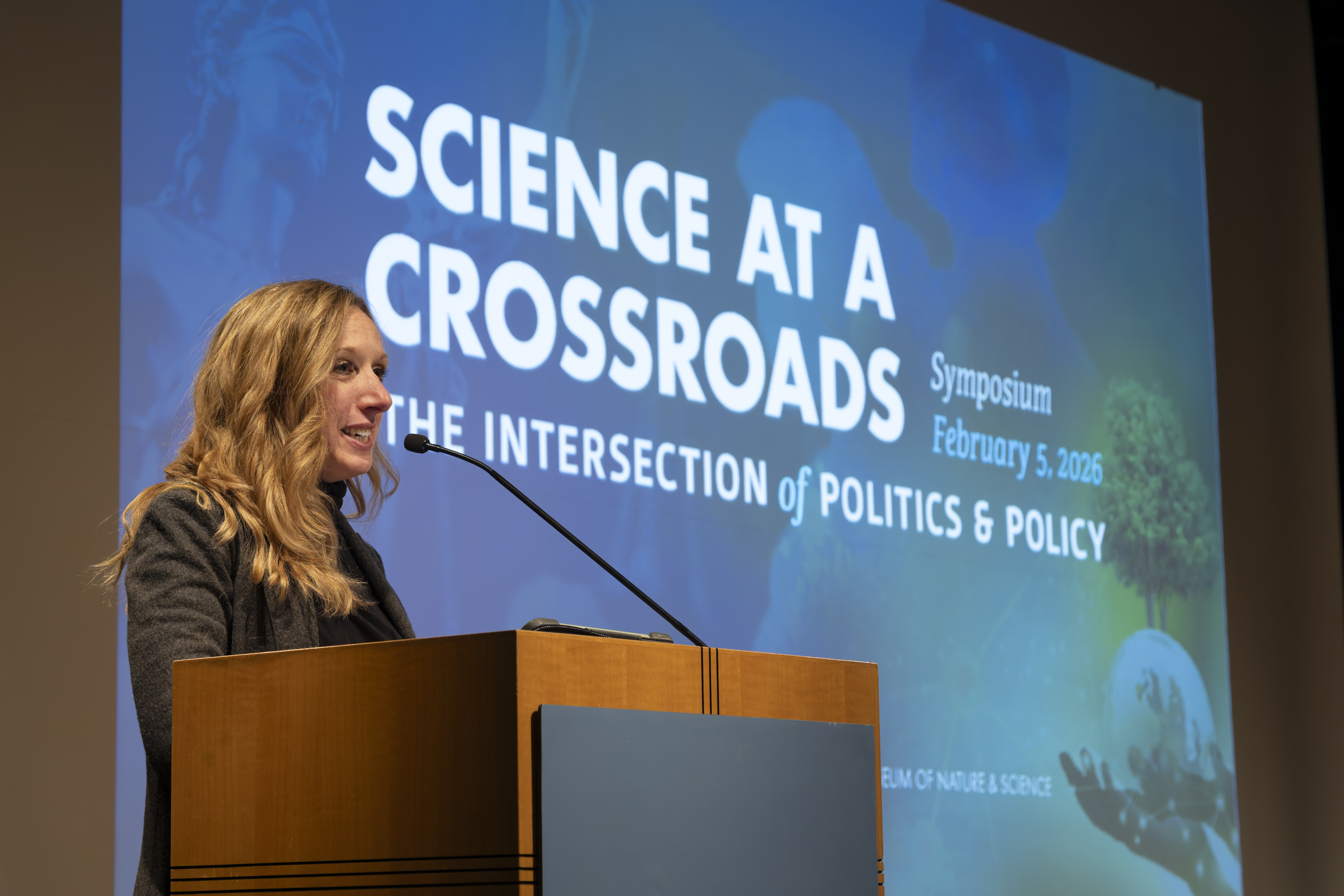
Institute for Science & Policy Executive Director Kristan Uhlenbrock welcomes everyone to the 2026 Symposium. (Photo/Rick Wicker)
The Institute for Science & Policy kicked off the year by hosting its 2026 Symposium, Science at a Crossroads: The Intersection of Politics & Policy, on February 5th for a sold-out crowd at the Denver Museum of Nature & Science. This was the first time bringing the annual Symposium back as an in-person event since 2019. More than 200 academics, researchers, policymakers, business leaders and community members enjoyed a stellar lineup of national and local speakers, engaging in a thought-provoking day of discussions on the state of science today.
This year's Symposium explored the changing landscape of federal funding for science, the role of politics and policy in shaping research and innovation and how we can navigate uncertainty with creativity and resilience. Speakers brought forward-thinking perspectives to examine historical context, current tensions and what’s at stake for scientific research in Colorado and beyond. Discussions throughout the day also offered strategies for more effective science communication and opportunities for rebuilding trust in science at a time when science has become politicized.
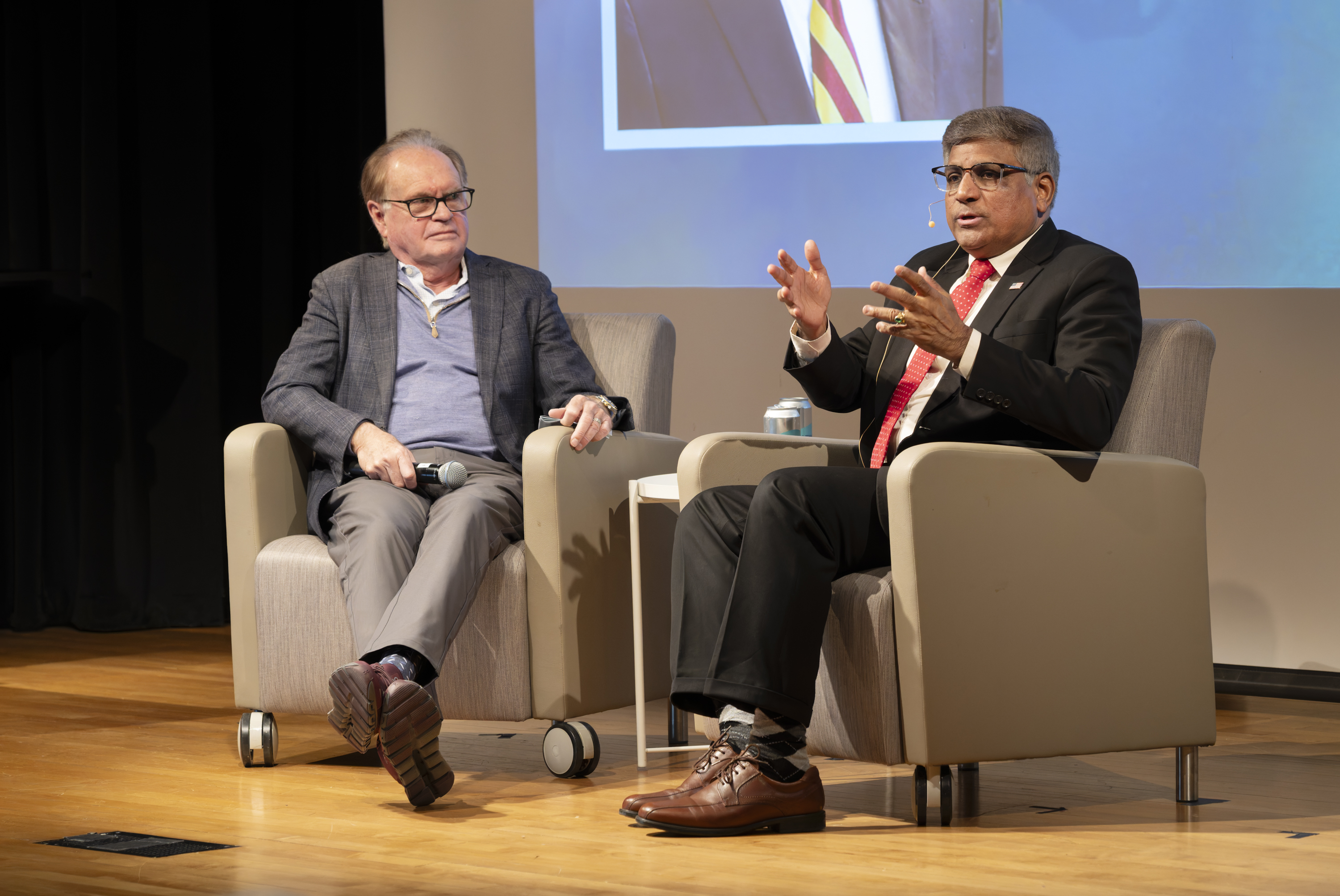
Denver Museum of Nature & Science President and CEO, George Sparks (left), in conversation with former NSF Director Sethuraman Panchanathan following his opening plenary, “Science the Endless Frontier”. (Photo/Rick Wicker)
Here are a few of the Symposium highlights.
Science and the National Political Landscape
Sethuraman Panchanathan, former Director of the U.S. National Science Foundation (NSF) from 2020-2025, kicked off the Symposium with his opening plenary, “Science the Endless Frontier”. His talk explored the importance and value of public research, the urgent challenges and opportunities facing science today and how we can ensure a robust future for science and its continuing impact on economic and societal prosperity. Following his talk, he sat down with Denver Museum of Nature & Science President and CEO George Sparks to discuss the challenges and opportunities in current federal funding prioritization and to take questions from the audience.
The next session featured a fireside chat on “The Politicization of Science”, another big picture look at the current science policy landscape. As polarization deepens and trust in institutions shifts, science has become a central point of political conflict in the U.S. Seth Masket, political scientist and professor at the University of Denver, sat down with science policy scholar Tony Mills of the American Enterprise Institute to break down the issues driving the politics around science before and after the last presidential election. They discussed how public attitudes and partisan narratives are evolving and what these trends mean for policymaking, scientific expertise and the future of public discourse.
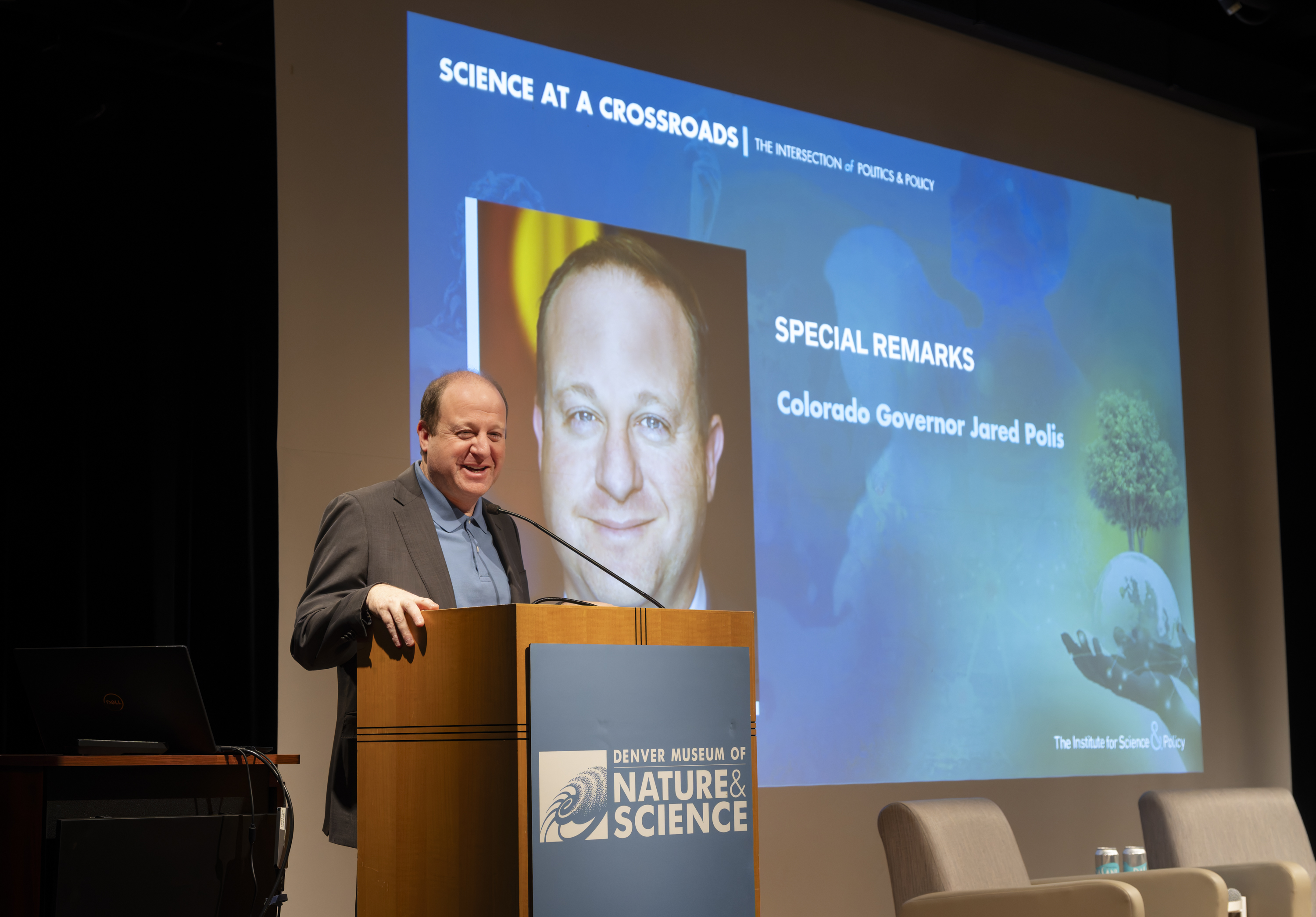
Colorado Governor Jared Polis gives a talk on Colorado’s commitment to innovation. (Photo/Rick Wicker)
Through a Colorado Lens
The big picture symposium themes were also brought down to a local level throughout the day. The morning sessions featured a talk by Colorado Governor Jared Polis on the important role of science and evidence in policymaking and how that drives Colorado’s leadership and continued commitment to innovation in science and technology. Later, a panel discussion on “Colorado’s Innovation Ecosystem” featuring local leaders from academia, business and government explored how Colorado's innovation, research and development landscape is responding to current funding and priorities. Throughout the conversation, they also highlighted the state's strengths, strategies and opportunities for leadership.
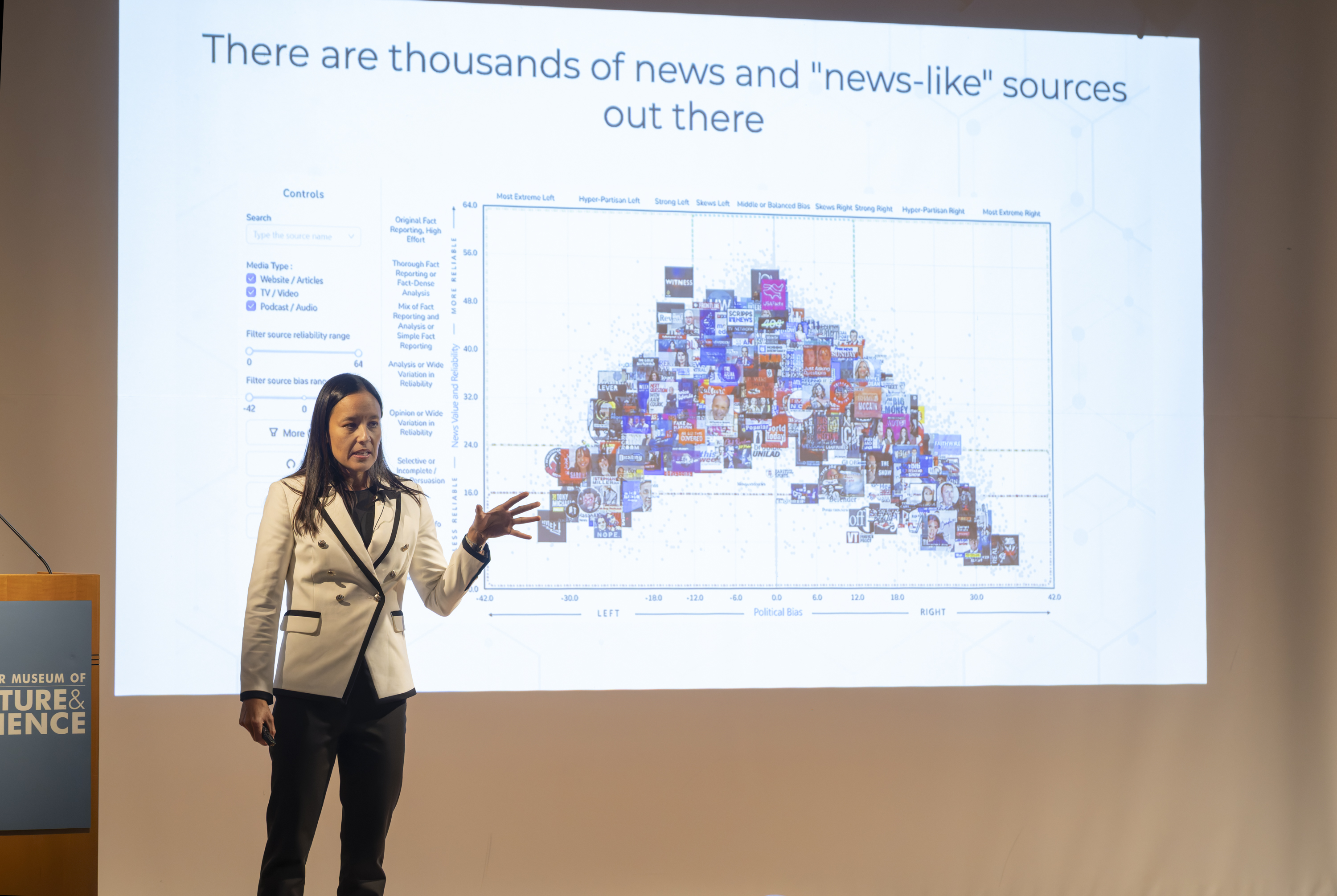
Vanessa Otero, CEO and founder of Ad Fontes Media, shares their trademarked Media Bias Chart in her keynote “Bias in the Media”.
The Power of Communication and Media
The two most popular sessions of the day focused on the power of communication from the broad to the individual level. In her keynote, “Bias in the Media”, Vanessa Otero, CEO and founder of Ad Fontes Media and creator of the Media Bias Chart, shared how to measure media bias and reliability with rigor, unpacked the media’s impact on science communication and offered tools for navigating today’s fragmented information landscape.
Equally important is learning how to bridge divides and build trust for effective one-on-one communication. Curiosity expert and author Scott Shigeoka engaged the audience in his keynote, “Curiosity is a Bridge for Connection”. Drawing on his research into fostering connection and healing division, he shared curiosity practices that anyone can use to strengthen understanding and connection, especially in an era of social and political division. His presentation emphasized that recognizing our shared humanity begins with getting curious.
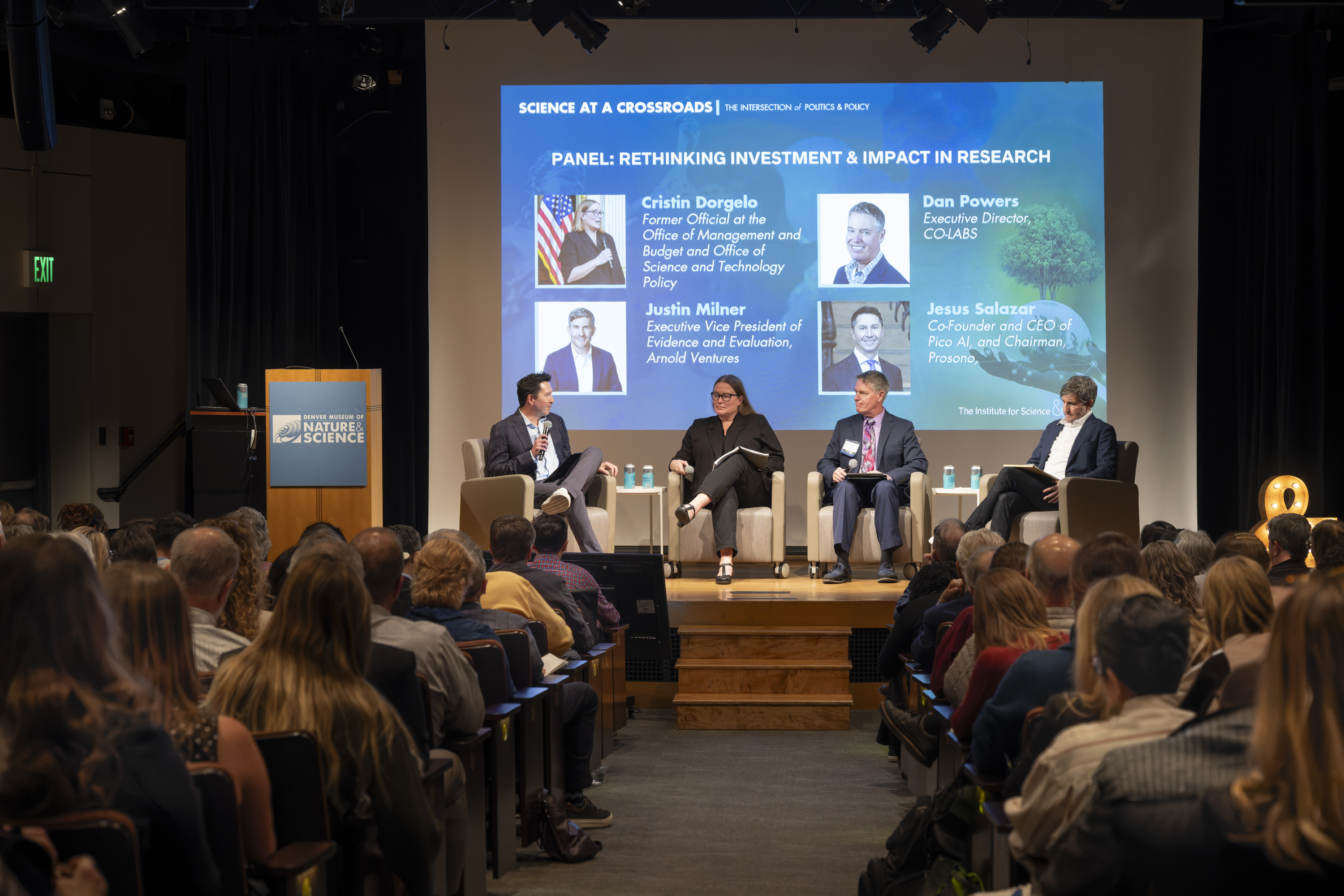
The Rethinking Investment & Impact in Research panelists (L-R): Jesus Salazar, Co-Founder and CEO of Pico AI, and Chairman of Prosono, Cristin Dorgelo, Former Official at the Office of Management and Budget and Office of Science and Technology Policy, Dan Powers, Executive Director at CO-LABS, and Justin Milner, Executive Vice President of Evidence and Evaluation at Arnold Ventures. (Photo: Rick Wicker)
The Future of Scientific Inquiry
Dealing with funding changes and shifting priorities under the current federal administration also took the spotlight during the Symposium. Federal research funding is contracting, creating gaps that new public, private and philanthropic investment models are attempting to fill. The panel discussion, “Rethinking Investment and Impact in Research”, explored the strengths and limitations of these models, what's at risk in the shifting funding landscape and new ideas to bolster research and its impact. With panelists representing both national and Colorado perspectives, the discussion ranged from the economic impact of research to ideas for accelerating innovation.
The Symposium closed with a fireside chat, “A Look Through the Optimist’s Telescope”, with author and innovation expert Bina Venkataraman in conversation with Institute for Science & Policy Executive Director Kristan Uhlenbrock. Together, they reflected on all the Symposium sessions and where we can go from here to advance both science and society. Venkataraman brought a unique perspective from her leadership roles at The Washington Post, The Boston Globe, The Broad Institute at Harvard and MIT and the Obama White House. She shared how research can move forward during uncertain times, what we can learn from other movements and generations and how we can adopt a forward-looking lens to shape the future of inquiry and progress.
Through thought-provoking conversations, success stories, and practical solutions, the Symposium challenged assumptions and spotlighted potential paths forward. For recordings of the sessions, along with a curated list of resources from speakers and a roundup of the top takeaways from attendees, visit the Symposium website.
Spring 2026
In This Edition
-
Is That Fossil Real?
How We Forge Faux Fossils in Earth Sciences
-
A 1938 Time Capsule: Jarre Canyon Diorama
-
A New Approach to Deinstalling a Legacy Exhibition
-
When Triceratops Dreams Come True
-
Our Gems & Minerals Hall Will Be Completely Renovated, Expanded by 50%
The Dea Family Gems & Minerals Hall: Unveiling Late 2027
-
2026 Symposium Tackles the Role of Politics & Policy in Science
-
Guest Curators Enrich Indigenous Textile Installations
Share this: