
CATALYST
DENVER MUSEUM OF NATURE & SCIENCE ONLINE MAGAZINE
Changing Colorado Landscapes: The Golden Eagle Diorama
By Garth M. Spellman, Director of Zoology and Health Sciences; Rick Wicker, Photographer DMNS; Wendy Shattil, Photographer.
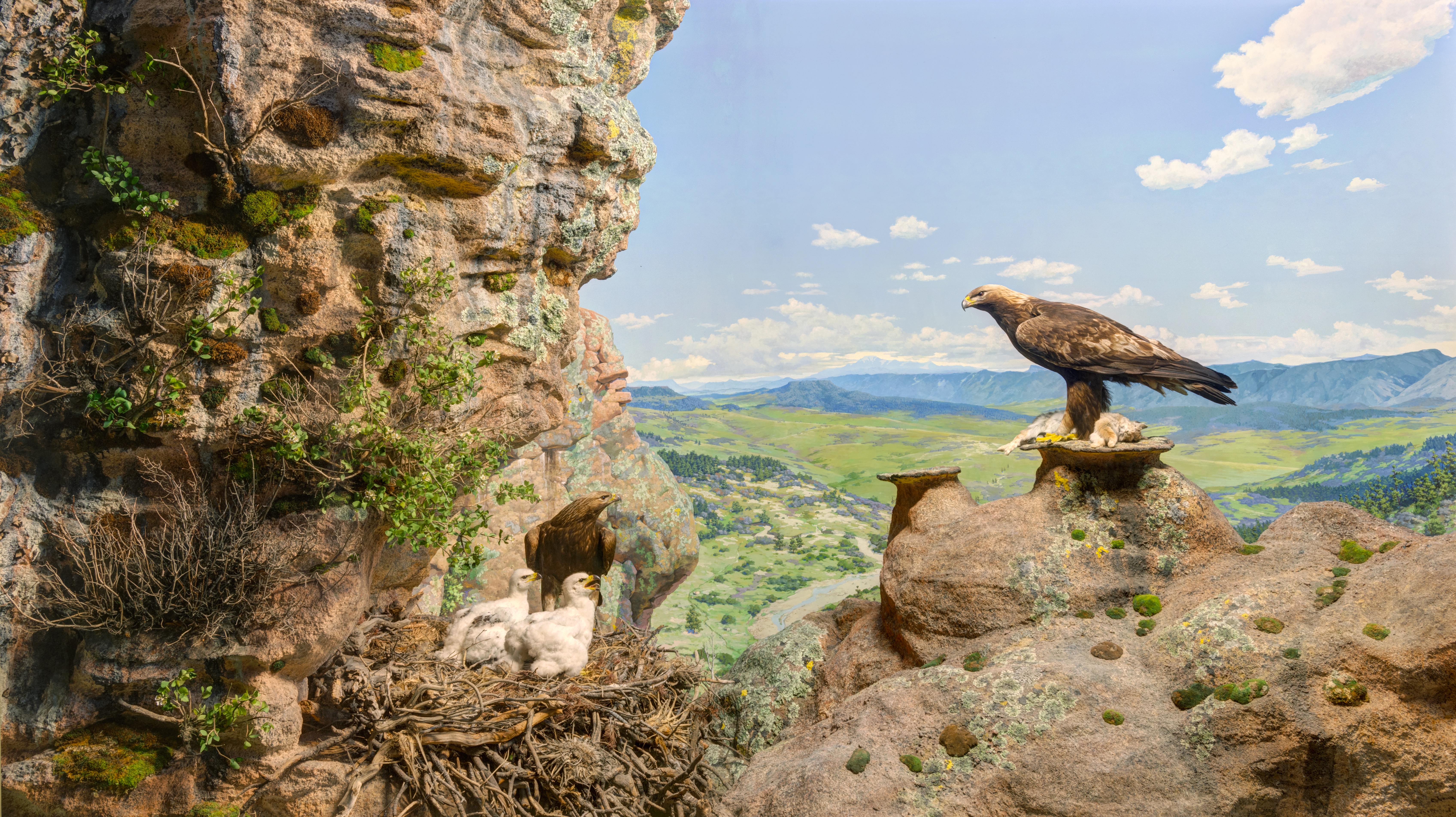
Golden eagles tend their young in the Museum’s 1938 diorama, inspired by a nest at McArthur Ranch south of Denver. (Photo/Rick Wicker)
In the Golden Eagle diorama at the Denver Museum of Nature & Science, a family’s afternoon unfolds against the foothills and distant Pikes Peak. An adult has brought a rabbit; the young wait at the nest, their attention fixed on the next meal.
Installed in 1938, the scene captures the intimacy of life on a cliff ledge, informed by hours spent watching a real nest south of Denver, where the rocks remain recognizable nearly ninety years later. Returning there today reveals how much can change around a place that appears, at first glance, to have hardly changed at all.
The nest itself began with an intervention. In autumn 1935, Robert Niedrach, the Museum’s curator of ornithology, found a promising ledge at McArthur Ranch and placed nesting material where he hoped Golden Eagles would settle. The following spring, a pair obliged. Niedrach and Museum director Alfred Bailey documented the birds during 1936 and 1937, gathering the observations and images that would help shape the exhibit. The finished diorama brought that ledge together with a painted background drawn from views near the Daniels Park overlook, several miles south. It was a scene was constructed through a combination of hard work, determination and imagination.
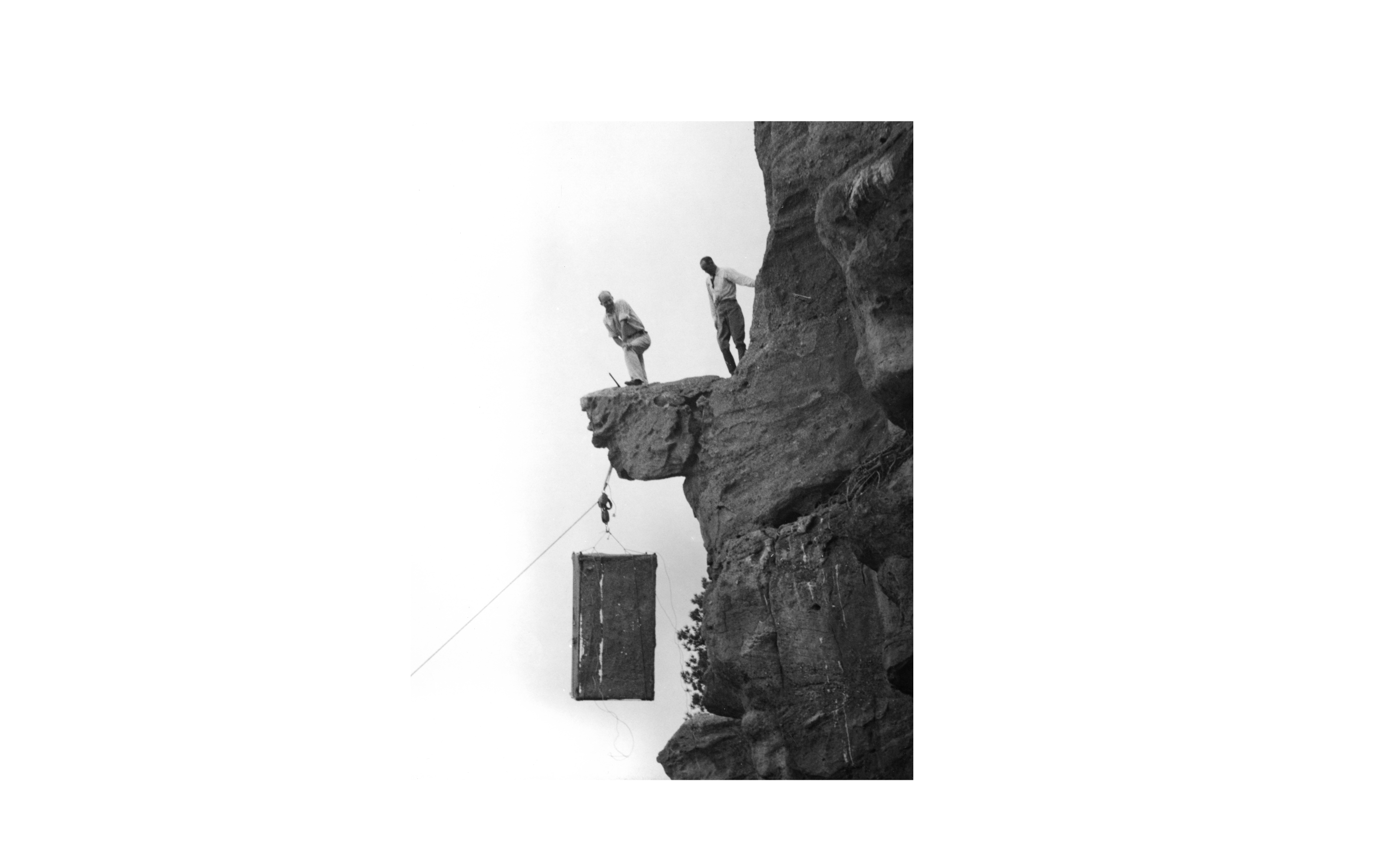
A suspended photographic blind brought Alfred Bailey and Robert Niedrach close to the eagle nest during the 1936–1937 fieldwork. (Photo/Denver Museum of Nature & Science)
The photographs and film captured by Bailey were not easy to obtain. He often spent an entire day working on a sharp rock with very little to show for it. He and Niedrach had to get creative and they eventually installed a canvas-covered wooden blind beside the cliff, using ropes and a pulley; one photograph shows the rope anchored to a car bumper. From this precarious observation post, Bailey recorded feeding visits, awkward wing exercises and long stretches when the adults stayed away. When the overhang repeatedly concealed an eagle’s head in shadow, the men took a hammer and chisel to the rock. The resulting pictures carry the ingenuity and determination of their makers, along with evidence of an approach to wildlife photography that belongs to another era.
Although his camera faced the nest, Bailey’s attention extended well beyond it. His journals describe Canyon Wrens bouncing across the rocks while singing their characteristic cascading song, towhees calling from scrub oak, and Lazuli Buntings contributing to the cacophony. A Sharp-tailed Grouse drummed while a Broad-tailed Hummingbird paused to examine its reflection in the lens of Bailey’s camera. Together, these observations evoke the prairie, shrublands and rocky recesses surrounding the eagles. They also give the diorama something its glass enclosure cannot supply: the sounds and movement of a larger ecological neighborhood, with the nest woven into its daily life.
The recognizable rock face at McArthur Ranch in June 2025. The ledges remain, while the landscape around them has changed. (Photo/Wendy Shattil)
Beginning in June 2025, photographers Wendy Shattil and Stuart Smith revisited that neighborhood, using archival photographs to recognize the original ledge. The cliff’s familiar contours offered a connection to the past, but the view from the ledge showed a landscape increasingly shaped by metropolitan Denver. Residential areas occupy portions of the former ranch, and roads and power infrastructure crisscross the surrounding country. Even golf balls scattered in the brush hint at the area's recreational use. Golden eagles have not nested at the ledge for decades. However, they remain in the area, part of the community: less than a mile away is an active nest site established in 2011 by a pair of eagles.
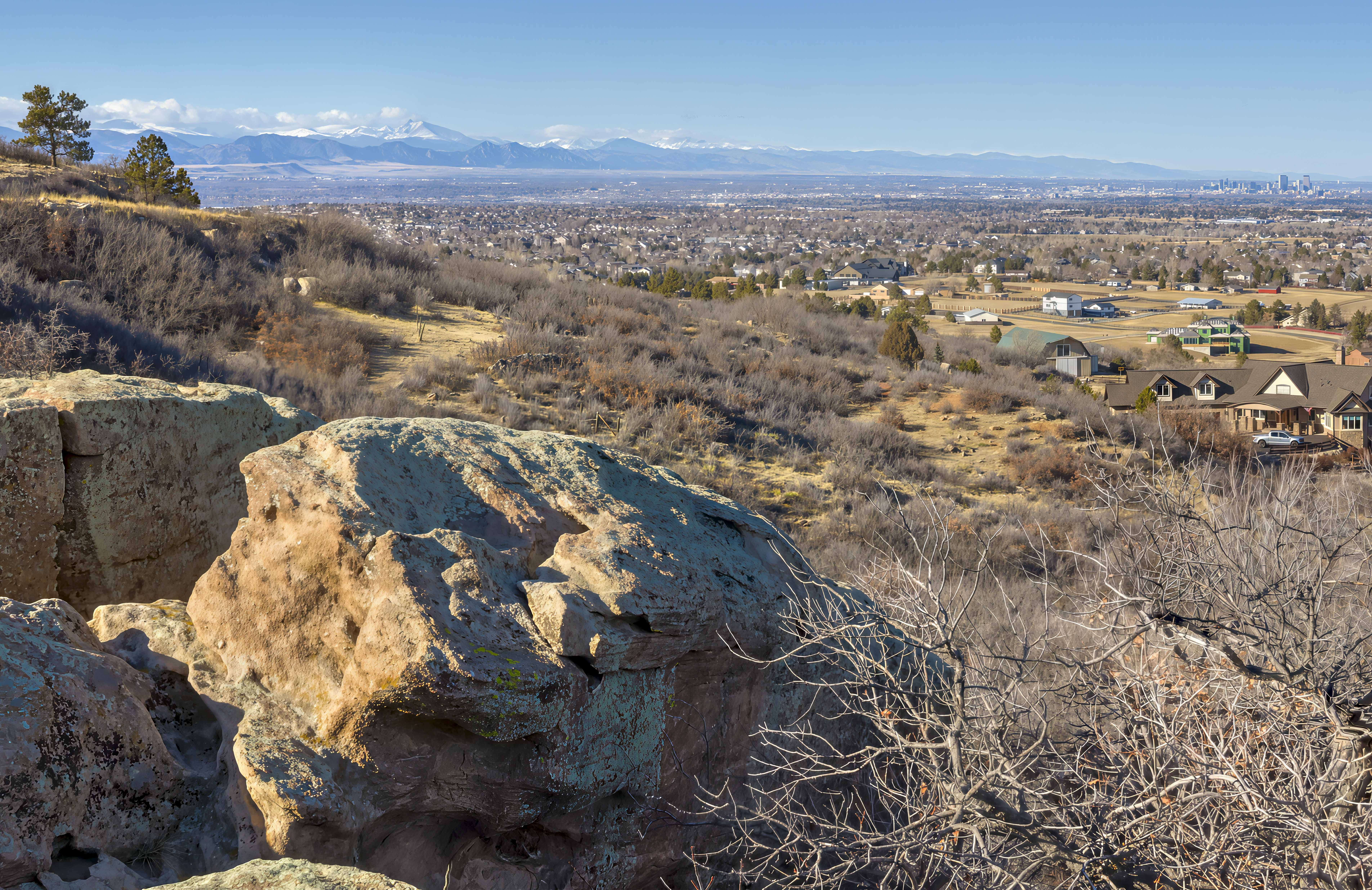
A winter view from the cliffs places the rocky habitat within today’s developed Front Range landscape. (Photo/Wendy Shattil)
Shattil’s and Smith’s photographs reveal that the ledge pictured in the diorama remains connected to nature. A downy Great Horned Owl fledgling peers from a tree; an adult rests nearby. Turkey vultures gather on the rocks and circle overhead, while other photographs show mule deer on the plateau. Spring flowers poke out from the grasses and leaf litter. These glimpses cannot measure all the ecological changes since Bailey’s and Niedrach’s visits, but they show how life continues within the altered surroundings.
A downy Great Horned Owl fledgling watches from the trees near the cliff in June 2025. (Photo/Wendy Shattil)
Perhaps the most compelling connection to the past comes not from the majestic Golden eagle, but a smaller, distantly related raptor. In early 2026, observers began following Prairie Falcons at the cliff. By late April, a pair was being watched near recesses close to the old eagle ledge. Bailey’s records also show that he photographed an adult prairie falcon and four young in the old eagle nest in 1945. The species had a history here. Seen through these photographs and journals, the diorama becomes an invitation to follow that history beyond the Museum—to revisit a familiar landscape, notice its absences, document its changes but also perhaps find comfort in the few things that have remained the same.
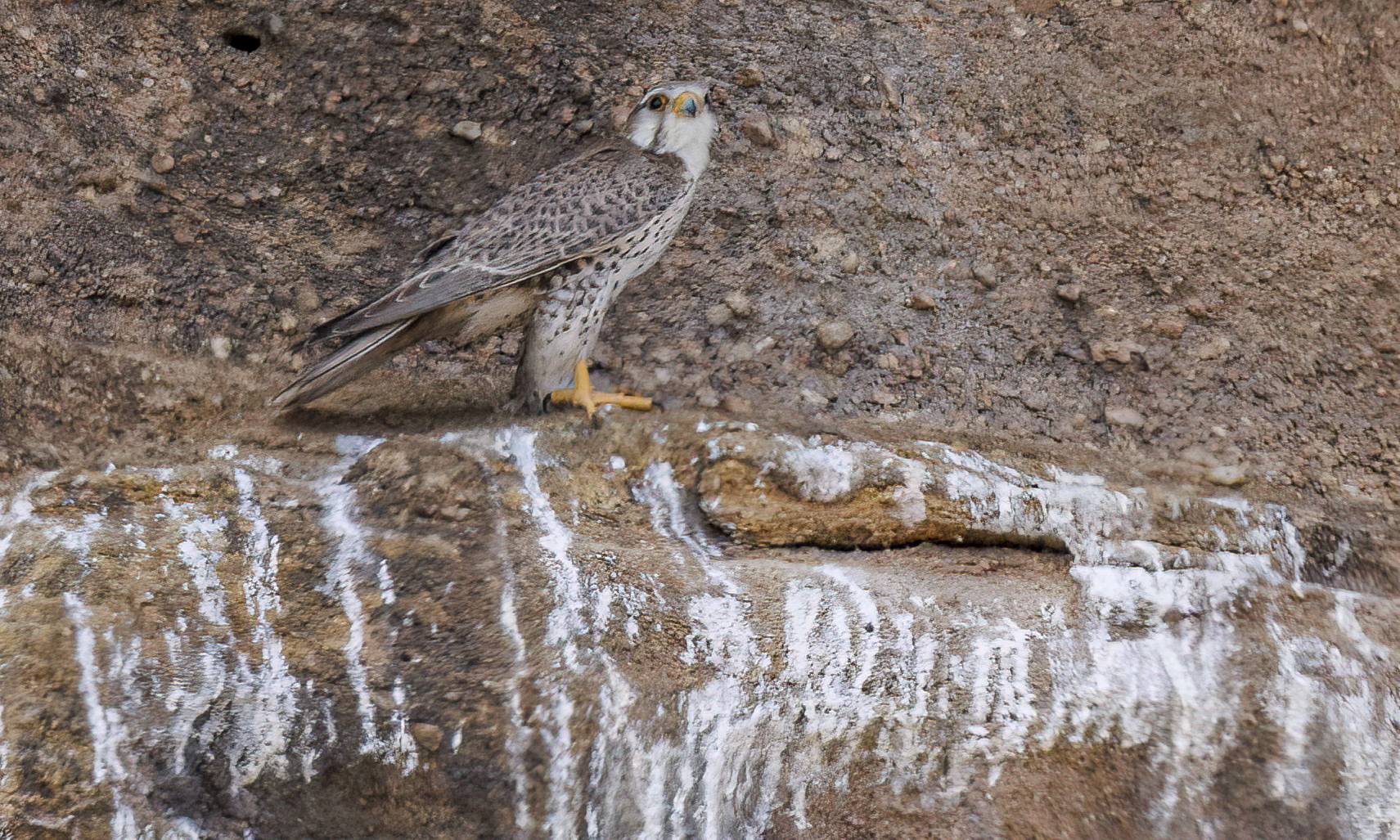
A prairie falcon perches on a whitewashed ledge at McArthur Ranch in March 2026. Bailey also documented prairie falcons using this cliff in 1945. (Photo/Stuart Smith)


